Portfolio + AI Career Assistant
It looks like an ordinary developer portfolio. Behind the admin login is a multi-stage AI agent that turns one job posting into a researched, fact-checked, ATS-scored resume and two cover letters. The fact-checker is deliberately blinded to the posting, so it can only verify claims against my real history.
The problem
- One job posting sets off dozens of small decisions.
- What shape the resume should take.
- Which experiences lead.
- Which keywords the ATS is scanning for.
- And the quiet one nobody admits to: do I stretch this claim, just a little.
- You pay that tax every time you apply: copy, paste, edit, second-guess, repeat.
- The writing was never the hard part.
- The hard part is that nothing checks your work.
- Nothing tells you whether the impressive line you just wrote actually lives somewhere in your own history, or whether you talked yourself into it because the posting wanted to hear it.
What it does
- You give it a job posting.
- It gives back a researched, fact-checked resume and two cover-letter variants, tailored to that posting and scored against its ATS keywords.
- Between those two points sit several stages, each doing one job under its own JSON schema:
- Company research runs a web search over the employer's site, recent news, and culture signals, then caches the dossier for thirty days so the next run against the same company is free.
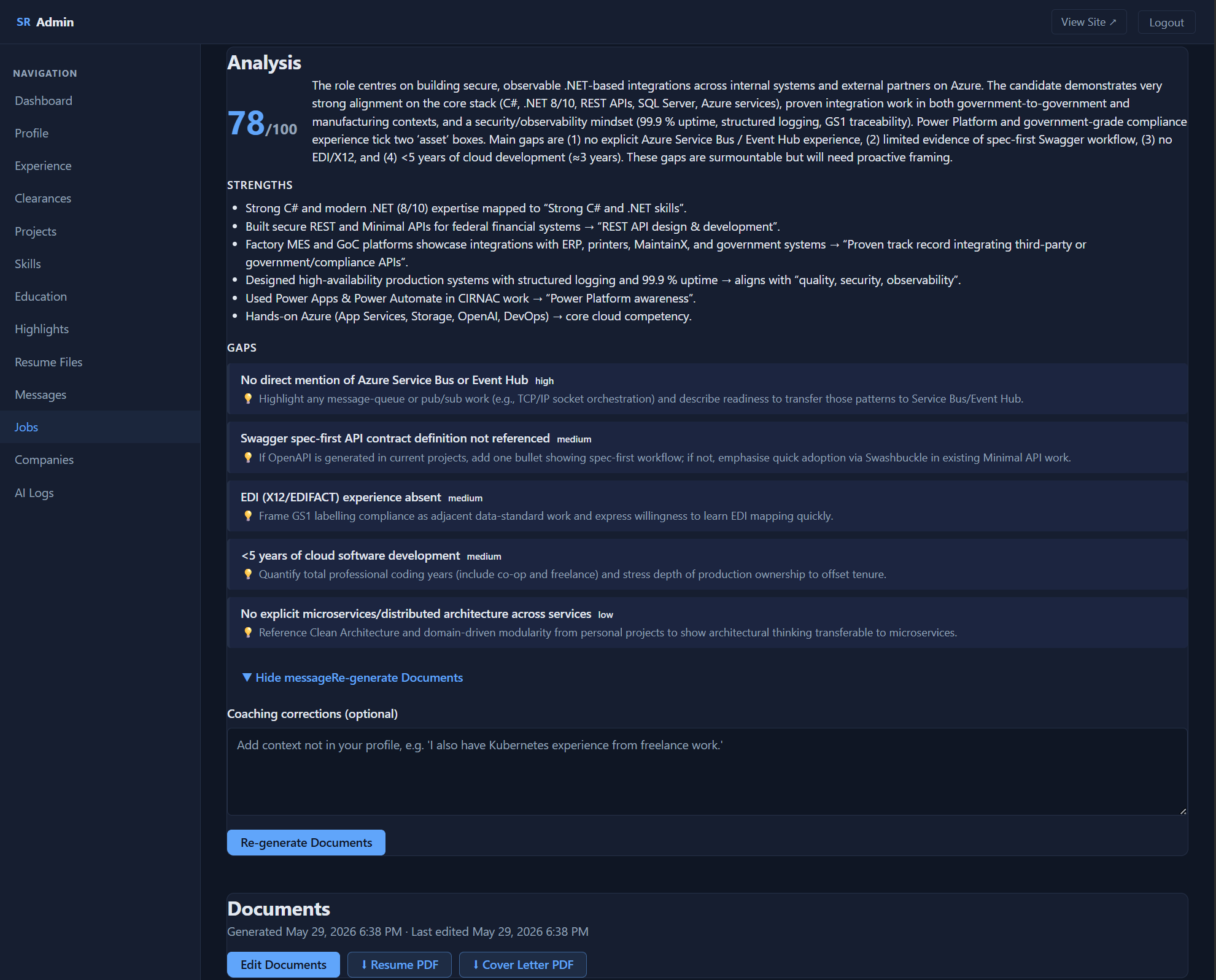
- Job analysis hands the posting and my profile to a reasoning model, which scores fit from 0 to 100 and returns severity-ranked gaps, matched strengths, and a keyword-frequency map.
- Generation drafts the resume and two cover letters in different strategic angles, bound by anti-fabrication rules and a list of banned openers, and steerable by coaching notes I type in.
- A humanizer pass rewrites against a saved sample of my own writing and audits itself for the tells of machine text.
- Then the part below: fact-check, critic, and grade.
- Government of Canada postings take a different branch, which I'll get to.
The fact-checking pass
- Before any document reaches me, a dedicated o3 stage reads every claim in the resume and cover letters and checks it against my raw profile, and nothing else.
- The design choice I care about is what this stage is not allowed to see.
- Its instructions are explicit: it does not get the job analysis or the company dossier, only my own history.
- That blindness is the whole point.
- A fact-checker that can see the posting will quietly rationalize a stretch, because the posting makes the stretch sound reasonable.
- Cut off from it, the model has no story to lean on.
- All it can ask is whether the claim shows up in my profile.
- It returns a verdict on each claim, supported, partial, embellished, fabricated, or unverifiable, with the exact profile line that backs it, plus a list of everything that needs revising.
- A second model then rewrites only the flagged spots; everything else comes back untouched, and if nothing was flagged it never runs at all.
- The studio shows me which claims are grounded and which are not, so I see the receipts before I send anything.
- One honest limit: this catches what the grounding stage flags.
- If that stage misjudges a claim, the critic won't save me, because there's no second independent judge behind it.
- It fact-checks every claim against my profile and flags the ungrounded ones.
- It does not promise zero fabrication.
Observability and graceful degradation
- Every model call in the pipeline goes through one gateway, and every call gets logged: the stage, the model version I asked for and the one OpenAI actually ran, the full prompts including the cached prefix, input and output tokens, cached and reasoning tokens, latency, and whether it succeeded.
- That log isn't a dashboard nicety.
- It's load-bearing for how the system fails.
- Each log writes on its own dependency-injection scope and its own DbContext, separate from the request, so it commits immediately and a failed log write can never corrupt the pipeline's change tracker.
- When OpenAI hands back an empty response, the gateway records the failure and throws an error that reads "try regenerating" instead of a stack trace.
- The payoff is that I can regenerate one piece at a time.
- If the resume draft times out, I retry just the resume, or a single bullet, or one project description, or one cover-letter variant, or a single merit-criteria answer, and only that field changes.
- Every edit I made elsewhere stays put.
- A slow stage becomes a button I press again, not a run I lose.
Auto-grading and output validation
- Every finished document gets a grade.
- Five weighted measures roll into it: keyword coverage and required-skill match at 25% each, then voice, grounded-claim percentage, and nice-to-have coverage.
- Voice is scored mechanically, not by feel: the score starts at 100 and loses points for em-dashes, for words off a banned AI-vocabulary list, and for sentences that are all the same length.
- Format safety is a separate pass-or-fail check, not part of the weighted score: bullets stay under two lines, the summary stays under four sentences.
- The total lands on a letter grade, A+ at ninety-five and down through the B range to C at sixty, with anything lower an F.
- The point is that I see a document's weak spots before I send it, not after.
- A regenerated resume that comes back a C tells me so instead of looking finished.
- Government applications run through the same grader, with merit-criteria coverage standing in for the usual checks and the grounded-claim percentage carried straight over from the fact-checker.
Under the hood
- It's one ASP.NET Core Razor Pages app on .NET 10, with a single SQL Server database behind both halves: the public portfolio and the assistant.
- Every model call returns structured output. Each stage's response is shaped by a closed JSON schema, unknown fields rejected and required fields enforced, validated as it deserializes into a typed C# object, so no stage parses free text.
- Two model tiers, split by job. o3 at high reasoning effort handles the judgment, job analysis and grounding. gpt-5.4 handles the rest: company research, drafting, the humanizer, the critic, and the government stages.
- Prompt caching is built in. A helper pads the static prefix, my profile and the rules, past OpenAI's roughly 1,024-token cache threshold, then appends the per-run content after a delimiter, and the cache hits show up in the per-call token counts.
- Company dossiers are cached for thirty days, so researching the same employer twice in a month doesn't bill twice.
- Resumes and cover letters render to print-ready PDFs through QuestPDF, in IBM Plex with a shared theme.
- The contact form uses anti-forgery and post-redirect-get. xUnit tests drive the Razor page models directly against an in-memory database and run the whole pipeline end to end against a fake model client with canned responses.
The Government of Canada track
- Federal postings get their own branch, switched on by a single flag on the application.
- A classification-research stage web-searches the Government of Canada standard for the position's group and level, so the writing matches the scope and seniority the classification actually implies.
- The pipeline pulls in my security clearances, their level, status, and dates, and a cached profile of the classification.
- From the posting it pulls out the Statement of Merit Criteria, writes a STAR story for each essential and asset qualification, grounds and repairs each one against my profile in its own fact-checking pass, and humanizes it.
- The cover letters switch to angles that suit the public service.
- I built this once.
- The next federal posting just flips the flag.
Stack
Full write-up
- The public site at saidrustom.ca looks like an ordinary developer portfolio — profile, experience, skills, education, and projects, every section editable through an admin CMS and served from SQL Server through EF Core.
- The real engine is behind the login: a job-application studio that turns a single posting into a researched, fact-checked, ATS-scored resume and cover letter.
- It is not one prompt to ChatGPT.
- It is a multi-stage agent pipeline where each stage does one job under a strict JSON schema, and the most important stage exists to distrust all the others.
- A run opens with company research — a web-search pass over the employer's site, LinkedIn, and recent news that produces a cached dossier (industry, size, product, culture signals, strategic angles, hiring-manager notes) with a 30-day freshness window.
- An o3 reasoning model then judges fit at high reasoning effort and returns a 0–100 score, severity-ranked gaps, matched strengths, an ATS keyword-frequency map, and the angle a hiring manager would actually respond to.
- Generation comes next: a tailored resume and two cover-letter variants, each bound to anti-fabrication and voice rules and steerable by the user's own coaching notes, followed by a dedicated humanizer pass that strips the tells of machine writing.
- Government of Canada postings get their own track that extracts the Statement of Merit Criteria, writes STAR narratives against each essential and asset qualification, and grounds every one against the profile.
- The part I am proudest of is what happens before anything reaches the candidate.
- A second o3 pass fact-checks every claim in the generated documents against the raw profile alone — deliberately blind to the analysis and the dossier so it cannot rationalize a fabrication — and returns a verdict on each claim with the exact profile line that backs it.
- Each document is then auto-graded: keyword coverage, required-skill match, format safety, voice, and grounded-claim percentage roll up into an overall score and a letter grade.
- Every model call across the pipeline is logged with its stage, pinned model version, prompts, token and cached-token counts, reasoning tokens, latency, and outcome, so a slow or failed call degrades into a plain "try regenerating" instead of a dead end, and any single section can be regenerated without touching the rest.
- Underneath it is a single ASP.NET Core Razor Pages app on EF Core and SQL Server: strict JSON-schema structured output on every call, prompt caching to hold cost down, a reasoning model for judgment and a fast model for drafting, print-ready PDFs through QuestPDF, and a contact form hardened with anti-forgery and post-redirect-get, all covered by xUnit integration tests.
- One database backs both halves — the portfolio you are reading and the assistant that tailored the application that put it in front of you.