MyAssistant - household operations platform
The app my household runs on, and the .NET 10 system I built solo to power it.
The problem
- A shared household runs on a hundred small obligations.
- Whose turn is it to take out the bins.
- Did anyone pay the internet bill.
- What's left in the grocery budget this month.
- Why is there a $40 charge on the bank statement nobody recognizes.
- Normally this stuff is scattered across group chats, a fridge whiteboard, two or three half-used apps, and whoever happens to remember.
- Splitting a bill turns into mental arithmetic. "Whose turn" turns into a quiet argument.
- I wanted one shared place that holds all of it, where the money math and the rotation logic are handled for you instead of relitigated every week.
What it does
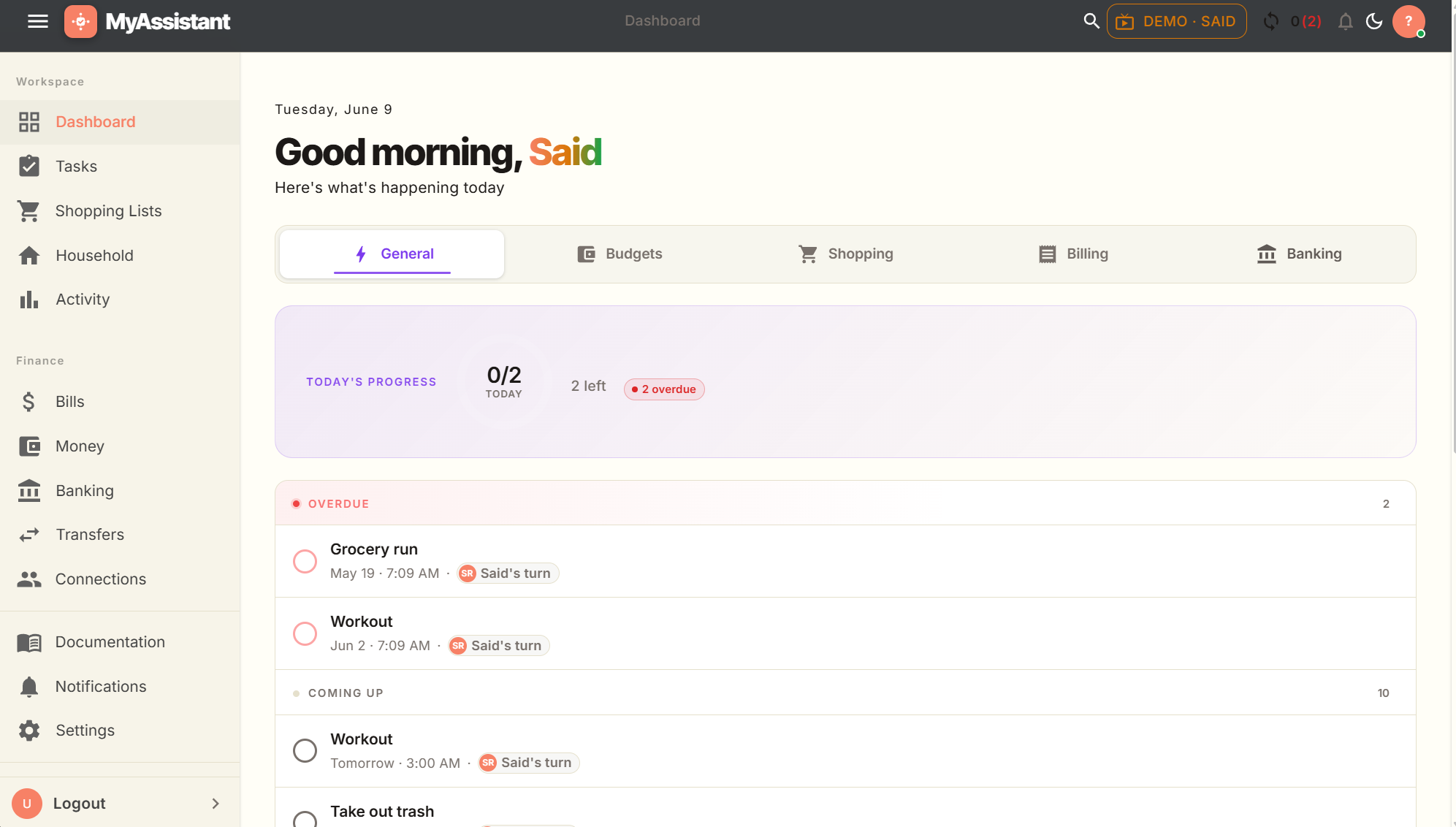
- It puts a household's day-to-day in one shared place.
- People in the same household get recurring tasks with a rotation that tracks whose turn is next, bills with line items and percentage splits that settle themselves, budgets funded from a personal wallet through a running ledger, and shopping lists with an in-store mode that groups items by aisle for the actual trip.
- The feature people react to most: you upload a bank statement PDF and the app reads it.
- It pulls out the account, the statement period, every transaction, and a category for each one, then checks its own arithmetic before saving anything.
- Receipts work the same way from a photo.
- Everything shared updates live across devices.
- There's a notification feed, an activity timeline, system-wide search, five switchable dashboards, an admin console, and a public demo anyone can open without signing up.
Under the hood
- I built it as a .NET 10 Clean Architecture solution where dependencies only ever point inward.
- The Domain layer has no idea EF Core or ASP.NET exist, and that's enforced by the project references, not by good intentions.
- Application sits on top with CQRS handlers, Infrastructure implements the interfaces, and the API stays thin.
- A few decisions hold the whole thing together:
- Expected failures return a Result<T> instead of throwing. A missing bill comes back as NotFound, a broken business rule as Invalid, and a controller extension maps each state to the right HTTP status. Exceptions are reserved for the genuinely unexpected.
- Only aggregate roots get repositories, and the rule is a generic type constraint, so asking for a repository over a child entity won't compile.
- Query logic lives in 173 named specification classes, never in the repositories or the handlers. BillByIdSpec knows how to load a bill with its lines and splits; the repository just runs it.
- Domain events are recorded inside entities as they change, but they fire only after the database commit succeeds, dispatched by an EF SaveChanges interceptor. A failed save fires nothing.
- Cross-cutting concerns are wired exactly once. Audit logging, the soft-delete query filter, exception capture, and validation all live in shared infrastructure, so every new feature inherits them for free.
- Realtime is convention-driven.
- A startup scan registers every aggregate root, and the SignalR hub authorizes a subscription by calling the same service method the REST endpoint uses, so the two can't drift apart.
- Plain CRUD broadcasts a change event automatically from that same post-commit interceptor, and a push failure can never roll back a write.
- Budgets don't store a balance anywhere.
- Every figure is folded on demand from immutable ledger entries, so the history is the source of truth and a correction is just another entry.
- The statement importer validates before it persists: it hashes the file, checks two unique indexes to reject duplicate uploads, and only then spends money on the LLM call.
The AI layer
- This is the part I'd point an AI engineer at.
- Five features are backed by OpenAI: bank-statement extraction, receipt parsing from a photo, free-text recipe parsing, grouping a shopping list by store aisle, and an admin tool that explains production exceptions in plain language.
- The plumbing around them matters more than the prompts.
- Structured output is guaranteed, not hoped for. A small generator reflects over a C# record and emits a strict JSON Schema, which goes to OpenAI in strict mode, so the bank-statement response deserializes into a typed object every time.
- Every call goes through one gateway that records the model, token counts, estimated dollar cost, latency, status, and a preview of the prompt and response. Admins can audit exactly what the app asked and what it cost.
- The demo account can't drain my OpenAI budget. The gateway counts a demo user's calls since the last reset and, once they hit the cap, throws before the HTTP call ever fires; a MediatR pipeline behavior turns that into a clean 400 instead of a 500.
- The receipt reader checks itself. It asks the model for line items, verifies they sum to the printed total, and when they don't, it sends the discrepancy back and asks again, up to three attempts.
Built solo, by the numbers
- I designed and wrote every layer myself, browser through database:
- 7-project Clean Architecture solution, roughly 118,000 lines of C# (about 68,000 once you exclude generated migrations)
- 30 REST controllers exposing 208 endpoints
- 203 CQRS handlers guarded by 94 validators
- 173 query specifications, 36 domain entities, 58 domain events
- 13 background services handling funding, reminders, alerts, and file cleanup
- 284 Blazor WebAssembly components and pages
- 1,154 unit tests
- 5 OAuth providers and 5 AI-powered features
A representative problem
- One bug is worth telling because it shows the kind of thing that eats real days.
- Completing a shared task started returning 500, but only sometimes, and only when a second person completed it.
- The completion itself had already saved.
- The cause sat three layers away: a child entity assigns its own Guid in its constructor, EF Core read that non-empty Guid as proof the row already existed, and when a notification appended a new actor it issued an UPDATE against a row that was never there.
- That threw inside a domain-event handler, poisoned the request's shared database context, and surfaced as a 500 on a completely unrelated endpoint.
- The fix is one line per child configuration.
- Finding it meant tracing a failure backward through the event dispatcher, the change tracker, and the request scope, then writing it up as a standing rule so the next entity can't repeat it.
Tech stack
- Backend: .NET 10, ASP.NET Core, EF Core 10 on SQL Server, MediatR, FluentValidation, Ardalis.Result and Ardalis.Specification, Mapperly for compile-time mapping, Scrutor for assembly scanning.
- Realtime and auth: SignalR, ASP.NET Identity with JWT, and OAuth through Google, Microsoft, Apple, Facebook, and GitHub.
- Frontend: Blazor WebAssembly with MudBlazor.
- AI and documents: OpenAI over a resilient HttpClient, PdfPig for statement text, Magick.NET for images.
- Other: RestSharp for Mailgun email and currency rates, WebPush for browser notifications, Swagger, and xUnit with Moq for tests.
Results
- It's live, and anyone can use it.
- You can register an account, or open the demo with one click and walk through tasks, bills, budgets, shopping, and a sample bank import without signing up.
- The demo resets itself, so explore freely.
- My own household uses it as our daily driver for chores, shared bills, and the grocery run, which is the test I care about most: software my family relies on every day rather than a screenshot in a repo.
- The button below opens the landing page, where "Try the demo" gets you straight in.
Stack
Full write-up
- One-line summary: A production, publicly launched household management web app (shared recurring tasks with rotation, bill splitting, ledger-based budgeting, shopping lists, and AI-powered bank-statement and receipt ingestion), designed and built end-to-end by a single engineer on .NET 10 and Blazor WebAssembly.
- Role: Sole architect and developer.
- Owned every layer: product design, domain modeling, backend, database, frontend, AI integration, realtime, auth, background processing, testing, and deployment.
- Status: Live and publicly accessible.
- Open self-registration plus a one-click public demo (auto-resetting sandbox).
- Dogfooded daily by the developer's own household for real chores, shared bills, and grocery runs.
- Type: Personal product, solo-built.
- Not an enterprise system with a large user base.
- Frame impact through engineering scope, architectural depth, and real daily use, not through user/revenue metrics (none exist
- See honesty notes).
- Verified scope and metrics 7-project Clean Architecture solution
- ~118,000 lines of C# (~68,000 excluding generated EF migrations) 30 REST controllers exposing 208 HTTP endpoints 203 CQRS handlers (MediatR), 94 FluentValidation validators 173 reusable query specifications, 36 domain entities, 58 domain event types, 19 EF Core migrations 13 background/hosted services (interval funding, rollover, alerts, reminders, occurrence generation, orphan-file cleanup) 284 Blazor WebAssembly components and pages (MudBlazor design system, PWA service worker) 1,154 unit tests (xUnit + Moq, TDD workflow) 5 OAuth providers (Google, Microsoft, Apple, Facebook, GitHub) plus JWT auth 5 distinct OpenAI-powered features Technical accomplishments (grouped, for bullet generation) Architecture and backend.
- Designed a strict Clean Architecture / DDD solution where dependency direction is compiler-enforced (Domain references no EF Core or ASP.NET).
- Used CQRS via MediatR
- Returned a Result<T> type (Ardalis.Result) for expected failures instead of throwing, auto-mapped to HTTP status codes so controllers stay thin.
- Restricted repositories to aggregate roots through a generic type constraint.
- Kept all query logic in 173 named Specification classes (Ardalis.Specification), out of controllers and repositories.
- Raised domain events inside entities and dispatched them strictly post-commit via an EF Core SaveChanges interceptor.
- Wired every cross-cutting concern exactly once: audit logging, global soft-delete query filter, exception logging to RFC-7807 ProblemDetails, and a FluentValidation pipeline behavior.
- AI / LLM engineering (spotlight).
- Integrated 5 OpenAI capabilities: bank-statement extraction, receipt OCR via vision models, free-text recipe parsing, shopping-list categorization by store aisle, and AI triage of production exception logs.
- Routed the LLM features through a single audited gateway that records model, prompt/completion tokens, estimated USD cost, latency, status, and prompt/response previews per call.
- Guaranteed schema-valid output by reflecting over C# DTOs to generate strict JSON Schemas and using OpenAI structured outputs (strict mode), eliminating parse failures on financial data.
- Built a self-correcting receipt vision pipeline that validates extracted line items against the printed subtotal/total and re-prompts up to 3x on arithmetic mismatch.
- Enforced cost controls for the public demo by counting per-reset LLM usage in the gateway and translating quota breaches into HTTP 400 via a MediatR pipeline behavior, preventing runaway API spend.
- Wrapped the OpenAI HttpClient with a standard resilience handler (retries + circuit breaker).
- Data and financial logic.
- Implemented a ledger-based budgeting engine that computes all balances on demand from immutable ledger entries (no stored balance fields), making history the single source of truth.
- Built an idempotent bank-statement import pipeline (validate-first/persist-last) using two unique indexes (SHA-256 byte hash + period overlap) and a deterministic post-extraction checksum, returning 409 with an opt-in overwrite path on duplicate uploads.
- Extracted statement text from PDFs with PdfPig before the LLM step.
- Implemented percentage-based bill splitting with automatic settlement, and delete-with-undo that round-trips a payment snapshot through the soft-delete interceptor to reconstruct ledger effects on restore.
- Realtime and frontend.
- Engineered a convention-driven SignalR layer: a startup reflection scan makes every aggregate root auto-subscribable, and hub authorization reuses the same service method as the REST read path, so realtime and HTTP access control can't drift.
- The post-commit interceptor broadcasts change events for plain CRUD automatically, with origin-exclusion validated server-side and push failures isolated so they can never roll back a committed write.
- Built the SPA in Blazor WebAssembly with MudBlazor across 284 components, including a mobile-first in-store shopping mode, role-gated admin console, system-wide search, switchable dashboards, and a PWA service worker.
- Security, auth, and infrastructure.
- ASP.NET Identity with JWT bearer tokens and 5 OAuth providers.
- Web push notifications (WebPush) and transactional email (Mailgun via RestSharp).
- Image processing with Magick.NET including decompression-bomb resource limits.
- API versioning (Asp.Versioning) and Swagger/OpenAPI in development.
- Quality and engineering judgment.
- Practiced TDD with 1,154 unit tests.
- Representative debugging win: diagnosed an intermittent HTTP 500 on shared-task completion that only occurred under concurrent multi-user access.
- Root cause was three layers removed: entities assign their own Guid PK in the constructor, EF Core read the non-empty Guid as an existing row, and appending a child to a tracked collection emitted an UPDATE against a nonexistent row, throwing inside a domain-event handler and poisoning the request's shared DbContext.
- Fixed it with a one-line ValueGeneratedNever() config and codified it as a standing rule.
- Separately, eliminated an EF ConcurrencyDetector crash by serializing search queries that shared one scoped DbContext.
- Mapping to common job targets Backend / .NET engineer: lead with Clean Architecture, CQRS/MediatR, EF Core, Specification + Result patterns, 208-endpoint API, background services, 1,154 tests.
- Full-stack engineer: add Blazor WebAssembly, MudBlazor, PWA, the convention-driven realtime layer, and end-to-end ownership.
- AI / LLM / agentic engineer: lead with the 5 OpenAI features, structured outputs from reflected JSON schemas, the cost/latency/token audit gateway, demo quota enforcement, the self-correcting vision pipeline, and prompt design for financial accuracy.
- Senior / staff / architect: emphasize the systems decisions (post-commit event dispatch, ledger-as-source-of-truth, idempotent import, realtime/REST auth unification, cross-cutting wired once) and the debugging-judgment story.
- Action verbs to draw from Architected, Designed, Engineered, Built, Implemented, Integrated, Shipped, Established, Enforced, Automated, Diagnosed, Optimized, Delivered.
- Honesty notes for the AI (do not violate) This is a solo, personal project, publicly launched and used daily by the developer's household.
- Do not fabricate user counts, revenue, team size, uptime SLAs, or percentage performance gains — none are measured.
- Legitimate impact framing: breadth and depth of a one-person full-stack system, the verified engineering metrics above, production AI integration with real cost governance, and "live software my household relies on daily" rather than a demo repo.
- All numbers above are code-verified.
- Keep them exact if cited.